Flip Side: A Wet Saturday on the Village-Hall Record Fair Circuit
There is a very specific smell to a village hall on a wet Saturday in November. Floor polish. Instant coffee. Somebody's bacon roll. And underneath it, faint but unmistakable, the dry cardboard breath of a few thousand secondhand sleeves, waiting.
By half nine the trestle tables are up and the first browsers are already in — the ones who arrived before the doors opened and are now pretending, quite badly, to be casual. By ten the room has that low, contented rumble of a place where nobody is in a hurry and everybody is, quietly, on the hunt.
Record fairs like this still happen in church halls, British Legion rooms and community centres in towns you have to look up. They are not cool. They are not curated. They are, in my view, the best shopping trip in the country.
The Van Arrives in the Dark
Ask a dealer what time they set off and you'll usually get a shrug and a time that starts with a four. They are the first people in the car park, unloading plastic crates on a trolley with a wheel that doesn't want to go straight. Thermos in one hand, float in the other, the whole operation run on decades of practice and a deep suspicion of anyone who arrives with a spreadsheet.
What they bring is not stock in the retail sense. It's a life's worth of accumulation, whittled down: a house clearance from a few streets away, a collection bought off a man whose dad used to run a shop, three boxes from a car boot that turned out to have one good thing in them. Each crate is somebody's taste, offered up for inspection.
Reading a Crate
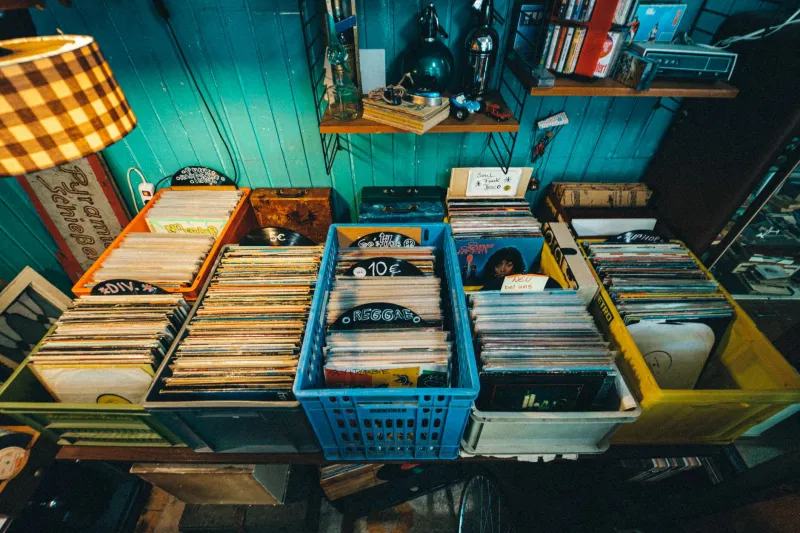
There's a technique to it and no two people agree on it. Some flip fast, a card-trick rhythm, eyes on the sleeve only. Some go slow, pulling the record out, tilting it to the light, squinting at the shine. Neither is wrong, but slow is better if you're new — you learn more from ten records handled properly than from a hundred flicked past.
Look at the spine first. Then the back cover, where the small print tells you the pressing, the year, the label. Check that the sleeve and the record match, because sometimes they don't and the dealer hasn't noticed. Look for a decent inner sleeve. A record that has been kept in its own polythene since the seventies is usually a record that was loved, and loved means cared for.
And listen to the boxes you'd never have chosen. The one marked 'misc / orchestral / spoken word' is where the strange, cheap, delightful things live. Nobody is fighting over that crate. That is exactly the point of it.
The Etiquette Nobody Prints
Every fair runs on a code that has never been written down and is enforced entirely through raised eyebrows.
Do not stand at a crate for twenty minutes doing your breathing exercises. Lift what interests you, tuck it under your arm, let the next person in. If you're going to be a while, say so — 'I'm going to be a bit' — and the queue dissolves politely.
Ask before you reach behind the table. Dealers keep their good stuff back there and most will happily pull out a box if you ask nicely; almost none will forgive you for leaning over the stock. Don't reshelve in the wrong place, either. Hand it back, or leave it on the end of the row. The floor is not a shelf and neither is the top of somebody else's crate.
And if you hear someone say a title out loud to a friend, don't swoop. Wait. There is more than one copy of most things, and you are not in a film.
The Five-Pound Rule
Go in with cash and a ceiling. Twenty quid, say, with a fiver of it set aside for something daft. The fiver box is where the fair earns its keep: the records with a scuff or a ring-wear, the ones with a name written on the label in biro, the oddities that would never survive a shop's curation process. Some of them will be terrible. One or two will be the best thing you've heard all year.
Late in the day is its own pleasure. Dealers do not want to carry crates back to the van and a quiet word about a bundle price is entirely acceptable round about three o'clock. What is not acceptable is doing it at half nine, loudly, in front of a crowd. Read the room. It's a small room.
Why the Algorithm Never Wins
Streaming gives you more of what you already like. A record fair gives you the thing you didn't know existed, filed in the wrong section, priced at two pounds, because a man called Dave thought you might like it. It is a physical filter for taste — imperfect, biased, occasionally maddening, and vastly more interesting than a queue of songs assembled from your own behaviour.
You also get to hold it. There's a small, unglamorous joy in walking home with a tote bag cutting into your shoulder, the damp feel of a sleeve that has been in somebody's loft since before you were born, a dealer's biro note on the back ('good B side'). That is a shopping trip with a story attached, and it cost you less than lunch.
How to Do It Well
- Take cash, including coins. Some tables are cashless now, but plenty are not.
- Go early for the rare things, late for the bargains. Both are worth doing at least once.
- Bring a strong tote and something to wipe your hands on.
- Learn three grading terms and use them kindly, not as a weapon.
- Ask the dealer what they'd take home from their own boxes. It is the fastest conversation in the world and it is usually a good one.
- Buy the strange thing. You can always sell it on at the next fair.
Then go and get a cup of tea from the urn, because you're in a village hall, and it would be rude not to. Outside, the rain is still going. Inside, sixty crates are being flipped through, slowly, by people who have nowhere better to be. There is no better place to be.