Knock Knock: The Quiet Style Codes of a British Front Door
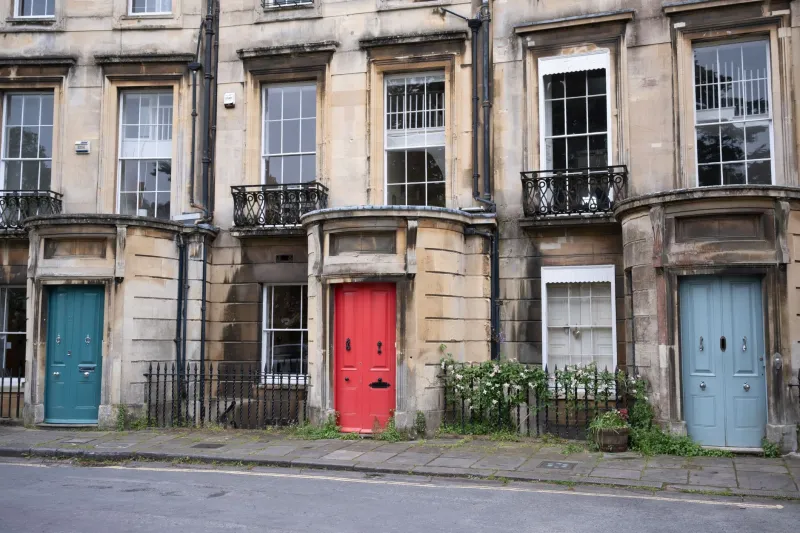
There is a stretch of terraces near me where the front doors are doing something quietly magnificent. One is a deep green so dark it looks black until the sun catches it. Next door is a cheerful custard yellow that has been applied with more optimism than undercoat. Between them sits a glossy black door with a brass letterbox polished to museum standards. Nobody has coordinated any of it. And yet the whole street reads like a conversation.
That is the thing about British front doors. They are public enough to be judged and private enough to be ignored. They tell you about taste, money, history and whether someone has given up on the hedge. But they also tell you about small acts of pride — the sort that don’t announce themselves. A swept step. A new house number. A lock that has been oiled rather than replaced.
At Rannel, we like this sort of thing: the characterful detail that sits right there on the pavement, free to look at. So here is a slow-walk guide to reading a street by its doors, plus a few notes on where to find paint, brass and number tiles when your own entrance feels like it needs a quiet word with itself.
The smallest stage on the street
A front door is a boundary object. It is the point where the street stops and the home begins, which means it carries more symbolic weight than any other bit of the façade. Windows are for light and nosiness. Roofs are for weather. The door is for arrival — and arrival is a performance, even when the performer is just a person in a wet coat trying to find their keys.
Victorian terraces, Georgian townhouses, 1930s semis, post-war council estates and new-build cul-de-sacs all have their own door conventions. But the interesting stuff happens when those conventions fray. A period property with a bright modern colour. A plain semi with an original stained-glass panel someone refused to rip out. A door that has been repaired so many times it has become a small museum of joinery. These are the details that make a street feel lived in rather than merely built.
Paint: inherited, hopeful, sometimes both
British streets are full of inherited colours. You can often spot a door that has been repainted in situ: paint on the hinges, a tidemark around the letterbox, chips revealing older layers like tree rings. Sometimes the colour is a family hand-me-down — the same dark blue that was on the door when someone moved in twenty years ago and has been touched up ever since. Sometimes it is a hopeful repaint job: a bold red done over a bank holiday weekend, slightly streaky at the edges, but undeniably a statement.
Both are good. A street where every door is the same shade of off-white is not a street; it is a spreadsheet. A street with a custard-yellow door, a sage-green door and a door that is technically 'aubergine' but reads as 'bruise' is a street with opinions. You don’t have to like the opinions. You just have to notice that someone had one.
Look for colour families, too. Coastal towns often lean into blues and greens. Market towns go for deep reds and blacks. Some streets have a quiet run of Farrow & Ball-style muted tones, which suggests a shared aesthetic or at least a shared decorator. Others have a single rebel door in hot pink. That door is doing more for the local colour palette than any planning document.
Brass, numbers and the theatre of arrival
Brass is a commitment. Polished brass says someone enjoys the ritual — the tin of Brasso, the old cloth, the small Saturday morning satisfaction of making a letterbox gleam. Dull brass with a bit of verdigris says the door has history and the owner has other priorities. Both are entirely respectable. The only real crime is cheap chrome pretending to be brass.
House numbers are where the street really lets its hair down. You will see painted numerals, ceramic tiles, brass figures, Dymo labels, enamel plaques, and the occasional hand-painted number that looks like it was done by someone who knows their way around a sign-writing brush. A ceramic number tile is a tiny act of self-publishing. A brass figure screwed on slightly crooked is a tiny act of honesty.
Then there are the extras: knockers shaped like lions, letterboxes wide enough for a small paperback, bells labelled 'Ring and wait' or 'Please knock'. One house near me has a hand-written card taped above the bell that says 'Sometimes broken. Always try.' That is not just a door. That is a whole philosophy.
Read repair, not wealth
Do not confuse money with care. A battered original door with a well-oiled lock and a swept step can outrank a new composite door with chrome handles and a security camera. Patina is information. A split panel that has been glued and clamped is a small victory. A bottom rail that has been planed because it swelled in the wet is a conversation between wood and weather.
Look at the bottom of the door especially. Drip marks, a kick plate, a cat flap, a temporary lock, a strip of draught excluder that has seen better days — all of it tells you how the entrance is actually used. A door that has been repainted around the hardware rather than removed is not a failure. It is a shortcut taken by someone with a tin of paint and a limited weekend.
Etiquette matters here. Admire from the pavement. Do not lean into porches, photograph strangers’ doorways close-up, or test a letterbox to see if it squeaks. The front door test is an exercise in looking, not intruding.
A weekend walk, properly done
Pick a street with a bit of variety — a mix of ages, a few shops, maybe a church or a pub at one end. Walk one side from top to bottom without stopping, then come back slowly. The first pass gives you the rhythm. The second pass gives you the detail.
Things to note: the colour families, original versus replacement doors, the state of the ironmongery, the style of the house numbers, the steps and tiled paths, the condition of the paint at the bottom edge. Keep a note on your phone if you like. End with a coffee. This is not a military operation; it is a pleasant way to spend an hour.
Where to find the good stuff
If your own door needs a lift, start with salvage. Architectural salvage yards, reclamation centres and local auction houses are full of original brass letterboxes, knockers, bell pulls and number plates that have already done a few decades of service. Salvo and the Architectural Salvage Register are good places to begin an online search, but the real pleasure is turning up in person with a tape measure and a vague idea.
For paint, British companies such as Little Greene, Coat and Farrow & Ball all offer strong period-friendly colours, but do not overlook your local decorator centre. A good colour match and a decent primer will do more for a door than an expensive tin applied over flaking gloss. For numbers, look to studio potters and ceramicists at craft fairs, makers’ markets and independent shops — a hand-made tile or painted numeral has far more character than a mass-produced plaque. And if the brass is tired, try restoring it before replacing it. A patient hour with a cloth and the right polish can bring back a letterbox that has been on the door since the house was built.
The test is not taste; it is attention
A street with varied doors — some polished, some peeling, some painted by someone who ran out of paint halfway — is a street with people in it. The front door test is not about finding the poshest entrance or the most historically accurate one. It is about noticing where someone has thought about the small theatre of coming home.
Next time you walk your own road, look at the doors. Not the houses. Just the doors. You will see the street differently — and you may find yourself giving your own a second look when you get back.