Drawer Diplomacy: The Case for Bringing Home a Tea Towel

Photo: Eric Jones, CC BY-SA 2.0, via Wikimedia Commons
There is a particular kind of souvenir that never makes it into the holiday photo. It does not sparkle, it is not shaped like a landmark and nobody will ever ask you where you got it. It lives in the kitchen drawer, gets covered in flour, soaked in tea and wrung out over the sink. And yet, year after year, it remains the most honest thing most of us bring home from a trip.
The tea towel is Britain’s great overlooked souvenir. Not the novelty one with a rude slogan, necessarily — though there is a time and a place — but the proper one. The one printed with a wonky map of a coastal path, a cathedral window, a local artist’s linocut of a heron. The one you bought for four quid in a church hall and have used every day since.
Why the tea towel wins
A fridge magnet is a message to other people. A tea towel is a message to yourself. It says: remember this. Remember the rain on the promenade, the smell of the second-hand bookshop, the hour you spent choosing between two nearly identical designs while someone behind you waited patiently for the till.
It is also, crucially, useful. That sounds like a small thing until you have owned a souvenir that isn’t. The miniature tin of shortbread gets eaten and forgotten. The decorative plate never leaves its box. The tea towel gets deployed. It dries glasses, covers dough, wraps warm bread, mops up the worst of a gravy incident. It is a souvenir that participates in your life rather than observing it from a shelf.
And it is affordable. In a year when a day out can easily cost the price of a decent pair of shoes, a tea towel is a low-risk purchase. You can buy one because you like the colour, or because the shop assistant was kind, or because it was raining and you needed an excuse to stay inside a bit longer. No guilt, no buyer’s remorse, no need to pretend it was an investment.
What a good one tells you
A tea towel is a pocket-sized editorial statement about a place. Cathedral shops tend to go for clean typography and architectural line drawings. Seaside arcades favour something louder — stripes, gulls, a cheerful disregard for tasteful restraint. Independent galleries often stock textiles by local makers, which means you are buying a small piece of someone’s practice rather than a licensed image of a lighthouse.
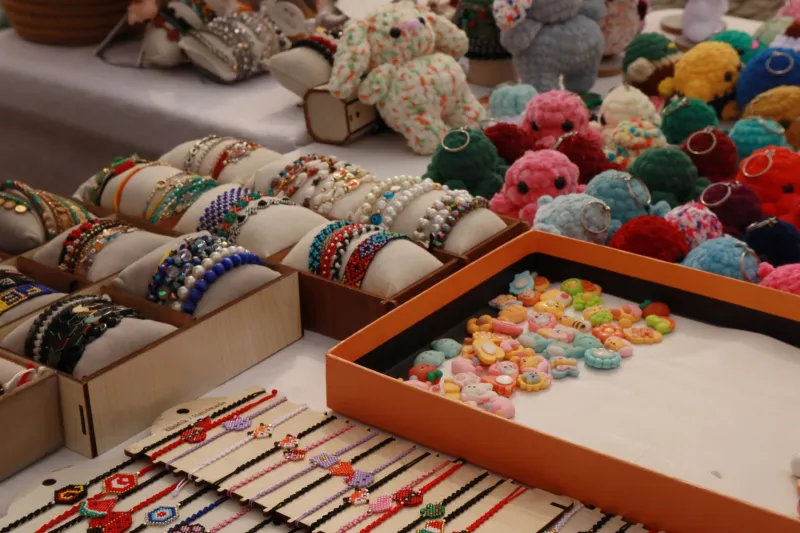
Village fairs are their own category. Here you might find hand-printed linen, slightly irregular hemming and a label saying ‘made in the shed at the back’. These are the ones worth slowing down for. They are not trying to be a brand. They are trying to be a useful thing with a bit of character, which is a much better ambition.
The design matters, but not in the way the souvenir industry thinks. You are not looking for a perfect representation of the place. You are looking for a trace of it. A colour that matches the cliffs. A pattern that echoes the tiles in the pub. A drawing that captures the specific oddness of a pier at dusk. The best tea towels look like they were made by someone who actually went there.
A field guide to buying well
First, touch it. A good tea towel has a bit of weight to it. If it feels like a napkin that has given up, put it back. Look for linen, cotton or a blend with a decent hand-feel. Pure novelty fabrics tend to smear rather than dry, which defeats the entire point.
Second, check the edges. A well-made towel has a proper hem, ideally double-stitched. If the print runs right to a raw edge, it will fray before the year is out. This is not a craft fair bargain; it is a future rag.
Third, look at the print. Cheap transfers sit on top of the fabric and crack after a few washes. Screen-printed or woven designs tend to last longer and look better as they soften. If you can see the individual dots of a halftone from a metre away, it might be more poster than towel.
Fourth, ask where it was made if the shop looks like it might know. Not because everything has to be local, but because the answer tells you something. A towel designed in Cornwall and printed in Manchester is a different object from one drop-shipped from a warehouse with a generic seaside graphic. Both can be fine. Only one is a souvenir.
Finally, buy one you would actually use. This is the tea towel test. If you cannot imagine it hanging on your oven rail or folded in your drawer, leave it. The point is not to start a collection. The point is to bring home something that makes the everyday slightly better.
The drawer test
A few years ago, I started keeping a small stack of tea towels from places I had been. Not displayed, not framed — just folded in the drawer, rotated through the week. Some are beautiful. Some are frankly a bit ugly. One has a map of a town I visited for a single afternoon and remember mostly because I missed a train.
That is the thing about this particular souvenir. It does not ask to be admired. It asks to be used. And in using it, you get a small, repeated reminder of somewhere else. You dry a plate and think of a cathedral shop. You cover a bowl of dough and remember a windy Saturday in a seaside town. It is not sentimental. It is just there, doing its job.
Fridge magnets have their place. So do postcards, pennants and the occasional snow globe. But if you want the souvenir that survives the journey home, the one that earns its keep and tells a better story, head for the kitchen drawer. Buy the tea towel. Use the tea towel. That is the whole test.