The Rain Stops at the Door: Britain's Free Glasshouses and the Art of a Wet Afternoon
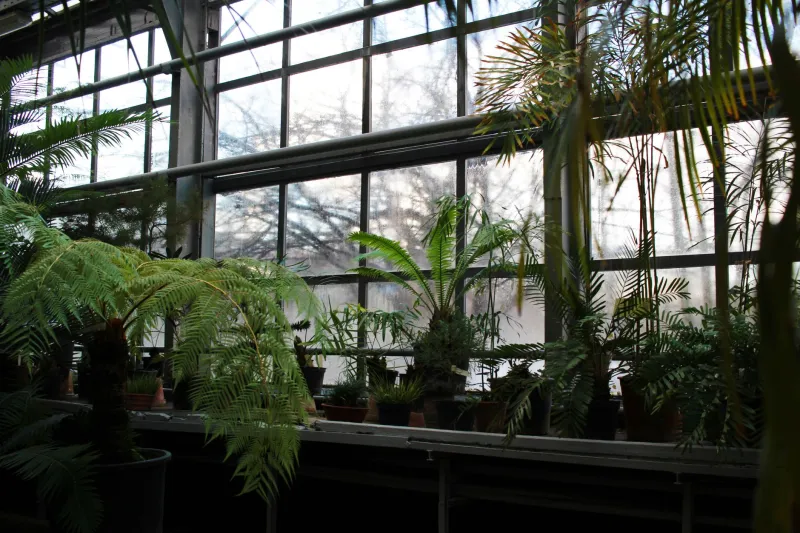
There is a particular kind of British November rain that doesn't fall so much as arrive horizontally, and there is a particular kind of British afternoon when you want to go somewhere that isn't your own front room but also isn't going to cost you the price of a decent Sunday lunch for the privilege of standing indoors.
This is where the glasshouse comes in. Not the ticketed botanical extravaganza with the gift shop and the £18 entry, though those are lovely too if the mood and the budget align. I mean the other ones — the civic palm houses and winter gardens that a Victorian town built to show off, that a modern council kept, and that still ask nothing of you except that you walk round slowly and stop moaning about the weather for twenty minutes.
Free. Warm. Slightly humid in a way that does wonders for a winter cold. Full of enormous leaves.
In 2026, with the price of a rainy-day outing creeping up and up, that's not a small thing. It's arguably the best-value day out left in Britain that doesn't involve a hill and waterproof trousers.
A civic gift nobody remembered to cancel
Most of these buildings come from the same burst of municipal self-confidence — the glasshouse as a statement, a bit of Kew brought to the provinces so that mill workers and clerks could stand among the palms of an empire they'd never see. Many were lost. The ones that survived did so through a mixture of lottery money, volunteer hours and sheer stubbornness.
Which is why the atmosphere is so specific. A public conservatory isn't a museum, and it isn't a park. It's closer to a library with better windows: a warm room where you're allowed to exist without buying anything, and where the only real requirement is that you don't ruin it for everybody else.
And there is something deeply reassuring about a place that's been warm and green and free since roughly 1875 and shows no sign of stopping.
The quiet etiquette of shared warmth
Nobody hands you a rulebook at the door, but the rules exist, and they're worth knowing.
Coat off, or coat carried. A glasshouse at twenty-two degrees and ninety per cent humidity will punish a wool overcoat. You'll end up steaming gently like a pudding and dripping on the tiled floor, which is a slip hazard and a social failure. Unbutton. Carry it over an arm. Accept that you look like a man mid-move.
Benches are shared, silently. The default is one person per end, maximum eye contact of about a quarter of a second. If somebody is reading, they are reading. If somebody is asleep, let them; they've clearly earned it.
Don't narrate the plants. There's always one bloke loudly reading the labels aloud to his wife. The labels are for all of us. Whisper.
Children run, and that's fine. A wet Saturday in a glasshouse is a gift to parents. Let them. It's not the V&A.
Stay a bit longer than feels polite. That's the whole point. Nobody is timing you. There is no queue behind you. This is the rare cultural space in Britain where lingering is actively encouraged, so linger.
And the golden rule: if there's a donation box, and there always is, and you've just had forty free minutes of warmth, put something in.
The short, opinionated list
Sheffield Winter Garden. The benchmark. One of the largest temperate glasshouses in Europe, planted into a long vaulted corridor between the Crucible and the Peace Gardens, and free to walk through at almost any hour. It has the advantage of being genuinely in the middle of a city rather than at the end of a park, so you can go in wet from a bus stop, dry out, then go and get a coffee without ever feeling like you've committed to an attraction. Go early; it's quieter and the mist inside is doing something lovely.
The Kibble Palace, Glasgow Botanic Gardens. The one that makes people take their hats off. Cast iron and glass and a curve of it that looks, from the outside, like a very grand and slightly mad relative's greenhouse. Free entry, and the surrounding Botanics give you somewhere to pace about afterwards when the rain eases into drizzle. A proper Glasgow afternoon.
Sefton Park Palm House, Liverpool. Grade II* listed, octagonal, and restored with a lot of love by people who clearly weren't going to let it go. Free to wander in during its public opening hours, and the acoustics mean there's often a choir or a string group or something on, which is either a bonus or a reason to check the listings first depending on your feelings about a cello.
Sunderland Museum and Winter Gardens. Free, and neatly solves the rainy-day problem of endless children by attaching a museum with a walrus in it to the tropical glass. The winter gardens themselves run hot and dramatic with a waterfall, which is the sort of thing that makes you say "oh" out loud.
The exception worth paying for. Birmingham Botanical Gardens and Glasshouses, if you want the full Victorian collection rather than the single showpiece. Not free, but the ticket buys you a whole afternoon and the foreknowledge that the roof fund is real.
Filed away for later. Great Yarmouth's Winter Gardens is one of the great restoration projects of the era — a cast-iron Victorian seaside glasshouse brought back from the brink. It's not an everyday option yet, but keep an eye on it. When it opens properly, make the trip.
What to actually bring
A cloth bag or backpack for the coat you've taken off. A tenner for the donation box and a cup of tea afterwards. A newspaper, if you're the reading-on-a-bench sort. And low expectations of the sky, which in this country is the correct setting for essentially every plan.
The tea, if it exists on site, is almost always slightly underwhelming and always worth it anyway. There's a specific joy in cupping a hot drink at a plastic table while water runs down the outside of the glass and enormous fronds shift in the heat above your head. You've paid nothing. You've gone nowhere. You've still had a day out.
That's the trick of the thing. Britain does this very well and half-forgets it's there. This winter, take advantage.